Brain, Arm and Pen: The Creative Tug-of-War of Ian Miller
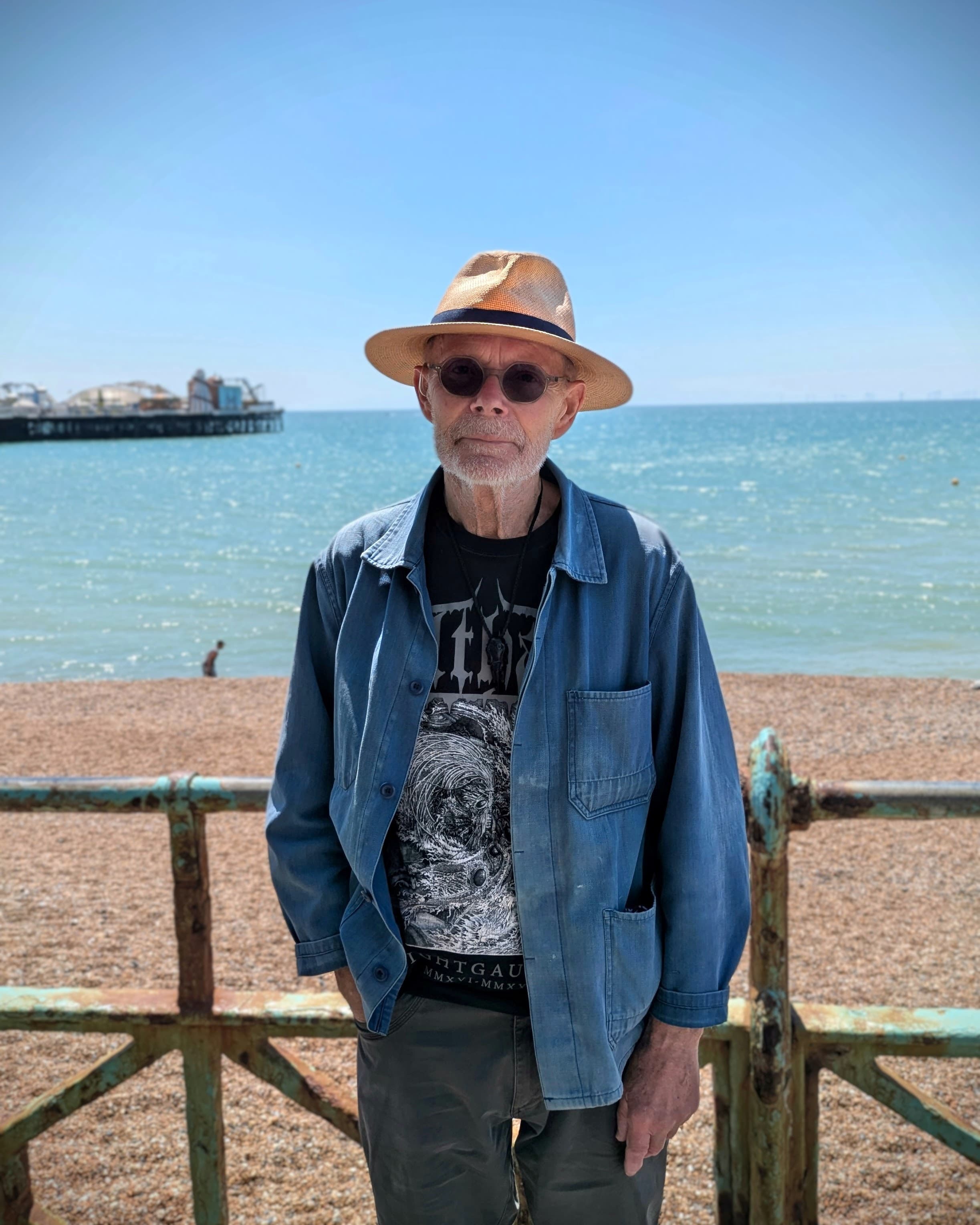
Ian Miller, Brighton 2026
Established Legacy
Decades later, that infinitesimal twitch between failure and success has guided Miller through a labyrinthine and wildly successful career. Today, working from his studio in Brighton, Ian Miller is happily engaged (some might say bemused) with a mix of art projects: some commercial, some wholly personal. Commissions from Erik’s Curiosa for Sorcery: Contested Realm are part of what he calls a “homespun Caucus-race,” a nod to the rules-free race from Alice's Adventures in Wonderland.
“Working with Erik’s Curiosa is a delight. Erik Olofsson is refreshingly straightforward, knows exactly what he wants, and chooses his artists accordingly,” he explains, referring to the founder of Erik’s Curiosa who enjoys working with commissioned artists personally.
Miller has created over 20 illustrations for the game so far, and recently selected three new assignments from a list of titles sent to him to feature in an upcoming set.
He is also actively involved in Osmoticmeld, a collaborative project with sculptors John Robertson and Danilo De Francesco. Together, they are bringing Miller's renowned two-dimensional artwork to life by transposing his designs into physical gaming figures and structures.
Over the last few years Miller has also been contributing to his impressive roster of almost 30 cards in Magic: The Gathering. He first started doing commissions for the collectible card game in the 90s. Then, there was a long gap with no further contact until around 2019, when he was approached to do some new cards for Wizards of the Coast. During this long lull, the cards created back in the 90s gained in popularity, and some of them are now eagerly sought after.
“Strange world, ain’t it?” he reflects.
A further four new cards are due for release in the next month or so for Magic: The Gathering. After this release, however, Miller has no plans to do any more card art for Wizards of the Coast.
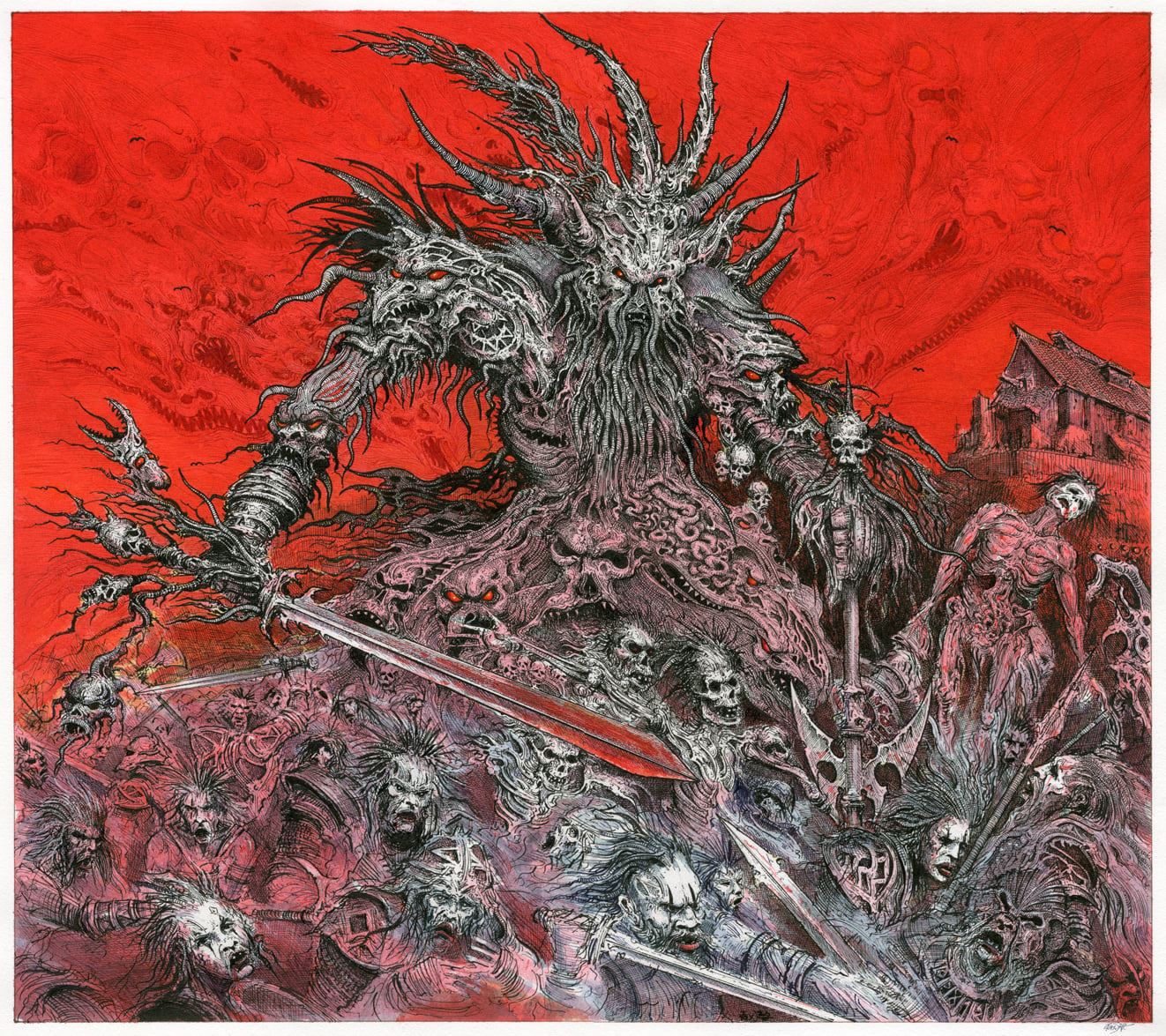
Miller’s career stretches back to the 1970s. Besides art for collectible card games, he has created imagery for Ralph Bakshi’s animated features, Wizards and Cool World, adding immensely to the world of fantasy and horror as we know it today. From The Tolkien Bestiary released in 1979 to Games Workshop’s Warhammer and Warhammer 40,000, he has built an extensive and undeniable profile.
“Legend, am I? I find that word really amusing. It makes me feel quite spectral. Perhaps it is because I have just been around for so long, and I'm still scratching marks on things. I must try invisible writing.”
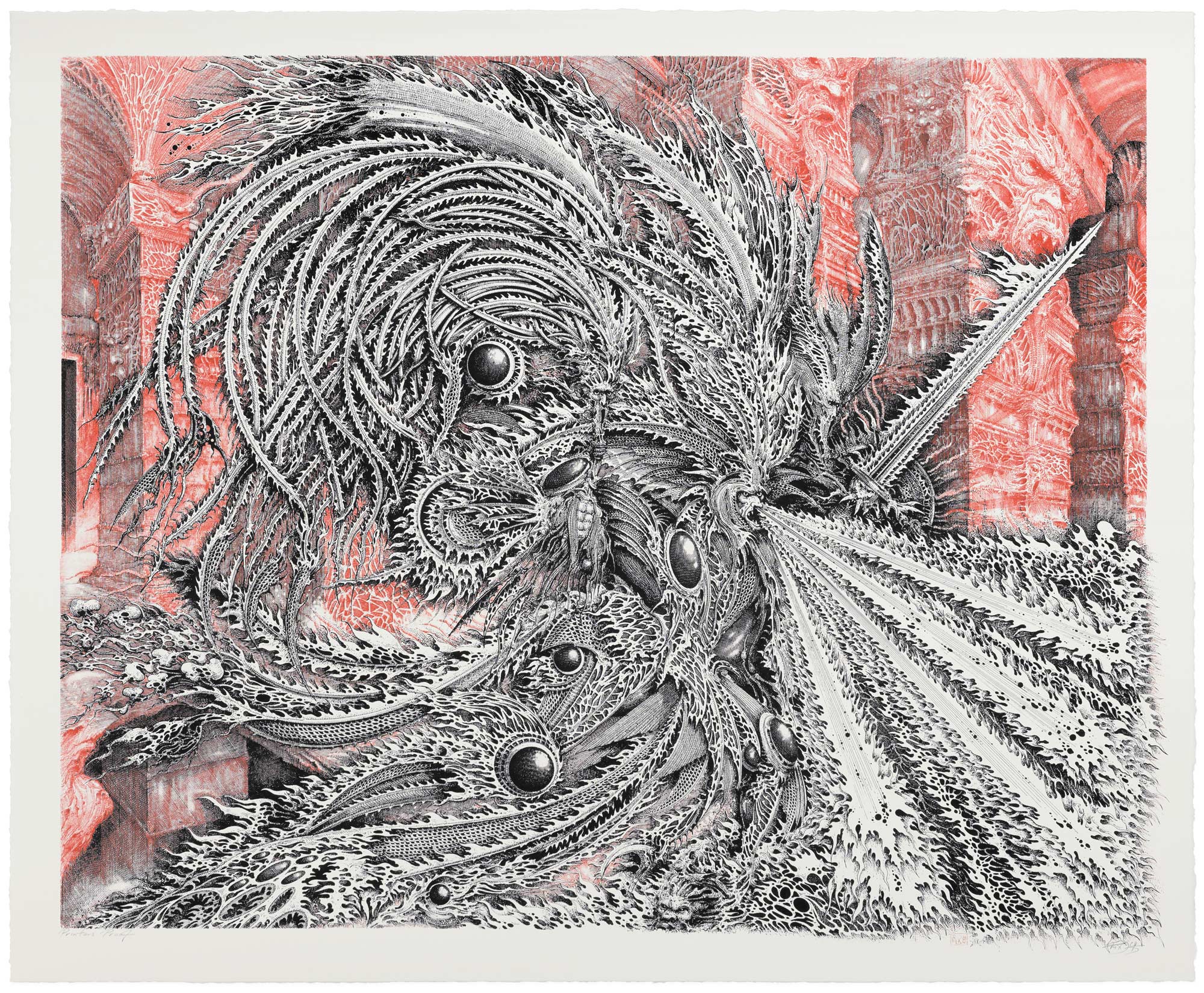
His work is distinct, typically filled with fine lines and stitched patterns. It screams with an extreme, intense detail. Spikes, scales, and teeth. Twisted, ghostly faces.
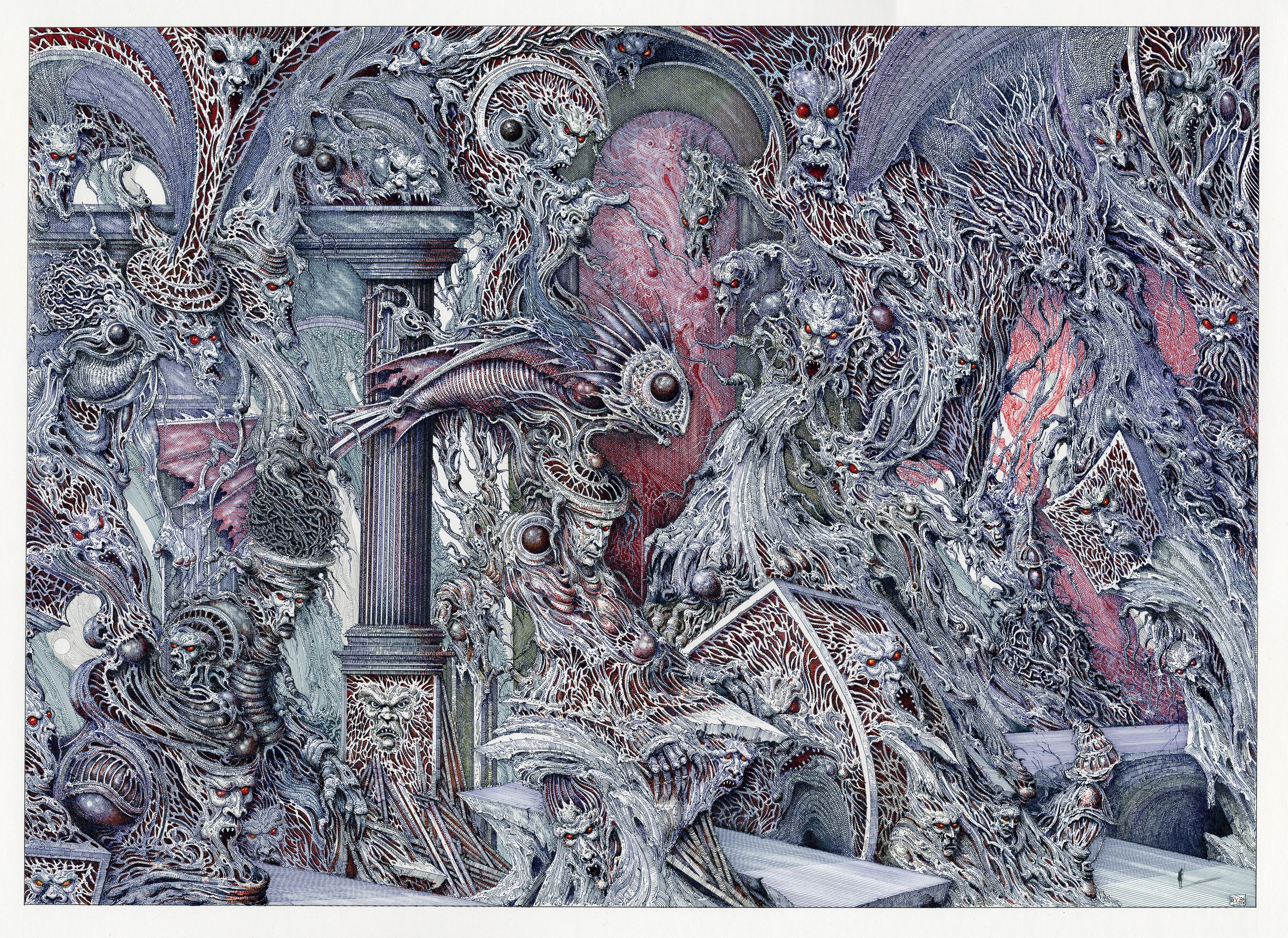
His style is reminiscent of 15th-century German painter Albrecht Dürer, who revolutionised engraving using fine lines and precision. But instead of focusing on religious imagery and the natural world, Miller’s subjects tend to be gothic and surreal.
He uses a pen-and-ink technique, and his use of colour is often limited. When included, it is mostly washed or monotonic. While he’s worked with the digital form over the years, he’s always been more comfortable with the tangible simplicity of traditional craft.
"In terms of my own well-being, I found that I’m actually happier when I am just physically drawing. It is me: my brain, my arm, and the pen."
Free Falling
Despite his mastery, Miller admits he’s never really been a fan of his own work. “I always feel it has fallen short in some way. This is not an uncommon feeling amongst creative people."
Miller approaches a new blank surface with a clear idea, mindful of the light and the restraints of the medium. But as the ink hits the page, a game ensues. The evolving image begins to make demands, drawing him into a relentless tug-of-war.
He describes this struggle not as a frustration, but as "an emotional, tactile, and intellectual whirligig of content, texture, and hues all vying for dominance, along with maybe a pinch of magic thrown in from elsewhere.”
He calls this Free Falling: a creative flux that takes you somewhere new and exciting, but also leaves you with a bag full of searching and unanswered questions. "There are disasters, of course, but that’s all part of the process, unwelcome though it might be.”
He once received a brief involving a matador and bulls. He accepted, but when it came to putting actual pen to paper, something just would not work. “I had a clear picture in my mind, but it would not transfer onto the paper surface, no matter how hard I tried.” He recalled having gone, out of curiosity, to a bullfight in northern Spain many years before, and walking away in disgust. This, he realised, the negative impact of that experience, might well be the problem, acting as a ‘brain-to-hand’ blocker. Whatever the case might have been, he asked for the brief to be assigned to another artist.
Other times, the block is purely mechanical, borne sometimes out of tedium at having to draw yet another dragon, cityscape, or a map of Tartarus.
“Last year, I was working on a very detailed dragon. What could go wrong? It was hardly groundbreaking work, but everything did.
“Try as I might, I could not attach a body to the finished head and neck. Fifty-odd years I’d been at it, and I was scuppered.”
Miller stashed the dragon’s head away in a drawer, where it remained untouched. One year on, he pulled it out of the drawer and went at it again, but from a different perspective, mindful of the Irish novelist Samuel Beckett saying:
“Ever tried. Ever failed. No matter. Try again. Fail again. Fail better.”
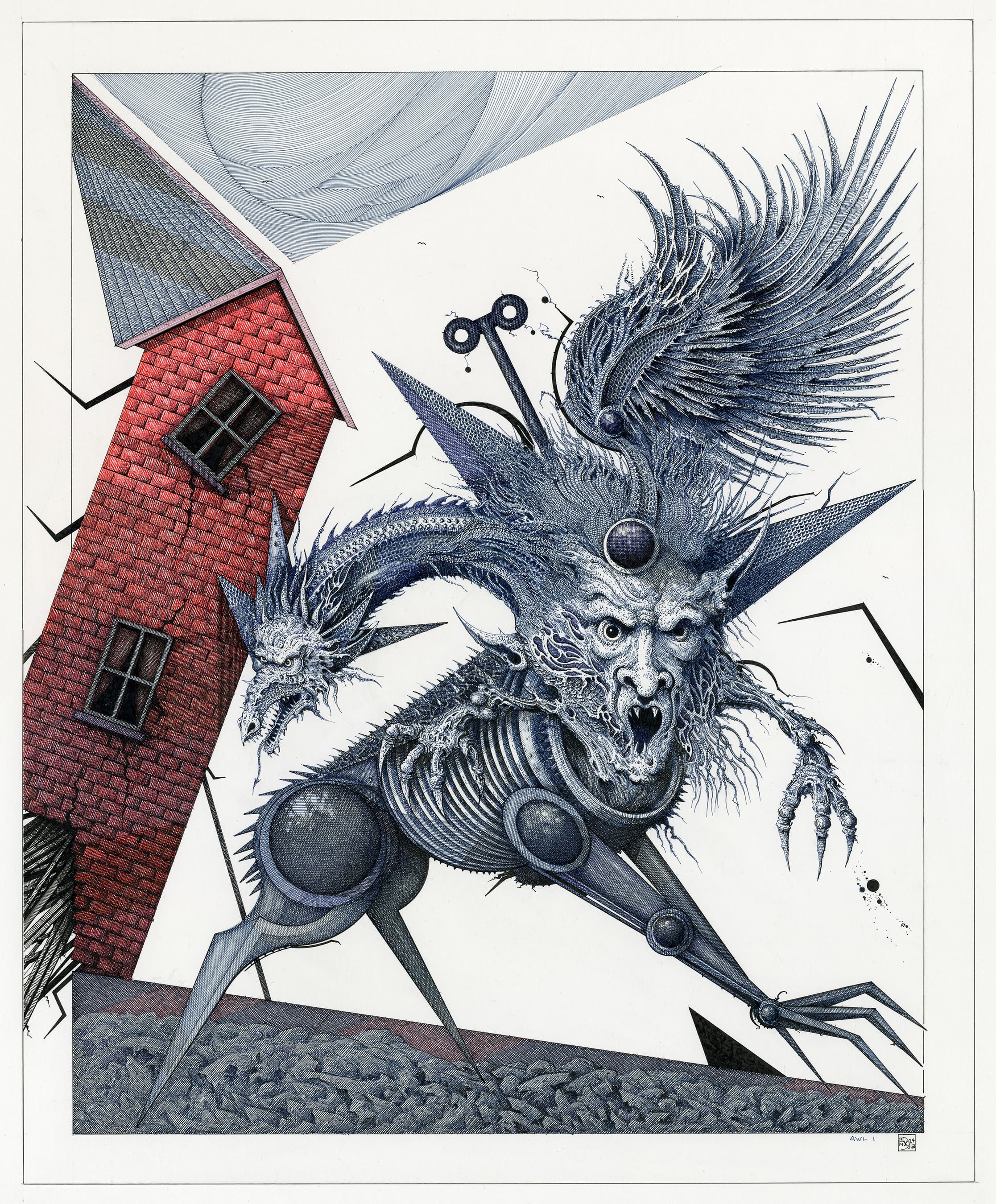
Miller ended up producing one of the few drawings that he actually liked. He grafted the dragon’s head onto the stylised body of a dog, and it worked beautifully. It’s called Awl 1.
“Huzzah! Sometimes, the long way round works just as well. I think every creative has to have a cussed streak in them, because I do not think they can survive without one."
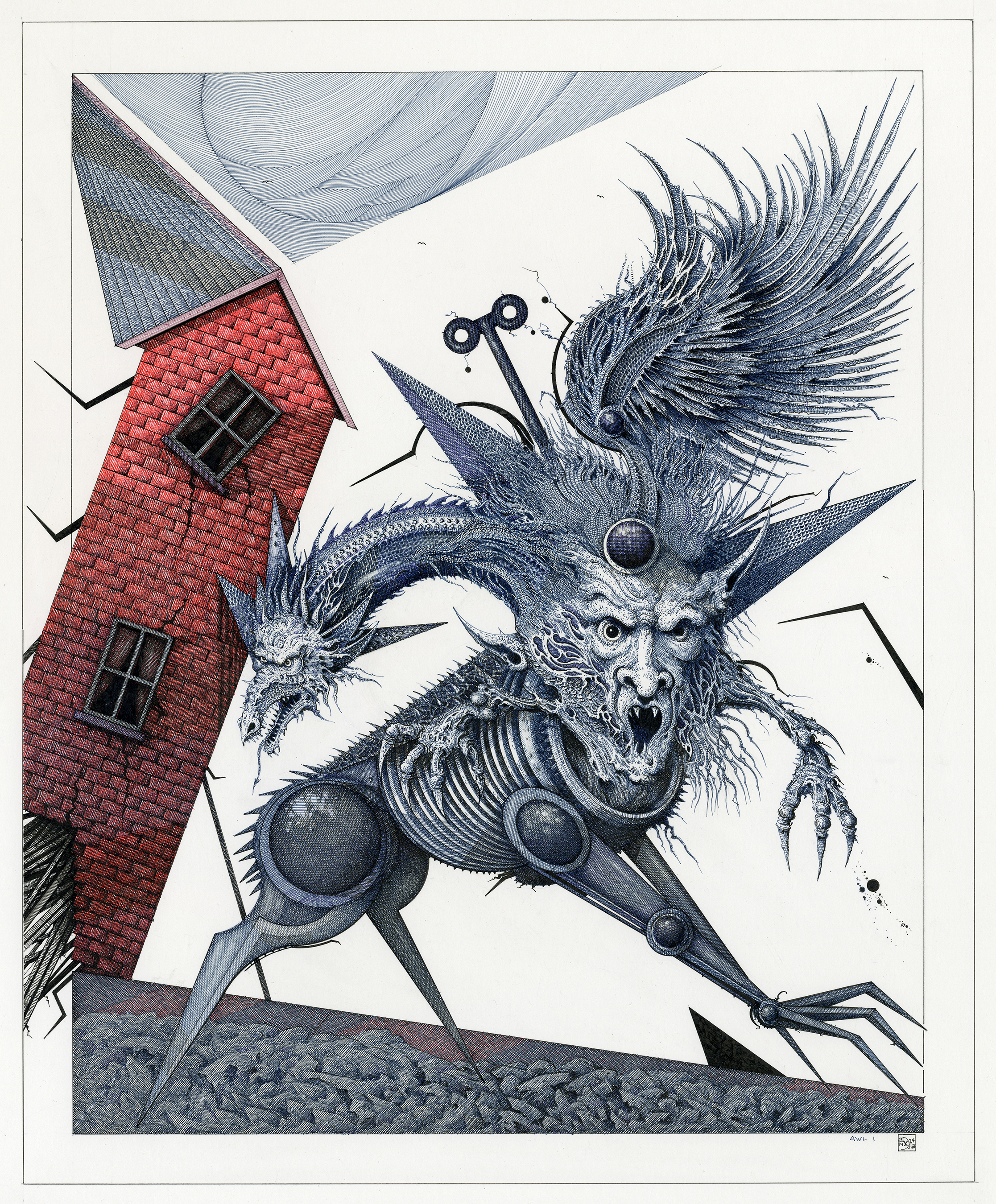
His visual work is filled with sharp edges and ghostly figures, but there is also a profound sense of play in his process. He also enjoys using language as a creative outlet, noting, “You play with language the same as you might play with shapes or sounds.”
Language, like art, is a fantastic vehicle, but both come with their respective limitations.
Miller quotes the German writer W. G. Sebald to further illustrate the point: “The sound of speech strives to express subjective and objective happening... but what of this it can contain is not life or the fullness of existence, but only a dead abbreviation of it.”
Celebrating an Ink-Stained Rebellion
Miller doesn't discount the intellectual weight of creating art, but he fiercely rejects the institutional habit of over-complicating it. He's always hated what he terms the institutional and esoteric trend of "over-intellectualising" and "obscuring" the working process. "It's akin to sticking a large sign up that says ‘Keep out, you won’t understand’ on the wall, rather than one that says ‘Come in and be moved’,” he contemplates.
The image must speak for itself. “The technician stops where the artist begins,” he recalls a former lecturer's words of wisdom. "I often see imagery that is technically brilliant, but it has no pulse, no inner life, and I always remember those words.
"There is magic in the creative process. You can’t pre-book it, buy it, or even invite it along, but when it appears, when it comes visiting, it touches you. Hold on hard.”
Art refusing to explain itself is a philosophy Miller shared with one of the few peers who truly understood the raw magic of the drawing board: the late John Blanche.
As fellow core artists for Games Workshop in the 1980s, Miller and Blanche helped forge the grimdark aesthetic of Warhammer and captured their shared, ink-stained rebellion in the iconic 1989 art book, Ratspike.
Though Blanche passed away earlier this year, their shared legacy will be celebrated once more with the upcoming release of a new book titled Rattle and Crow, a spiritual successor to Ratspike. Currently in its design phase, the book serves as a final, shared testament to two titans of the slow craft. It's also a reminder that even after half a century, Miller is still out there, chasing that infinitesimal twitch that he first learned to look for at the Mortbane Academy as a nine-year-old boy.
Sign up to the Haystack Newsletter.
Keep reading
A year in a drawer
Ian Miller couldn't finish a dragon, so he put its head in a drawer for a year. Awl 1 is what came out.
Drew Tucker on Folklore, Family, and the Living Canvas
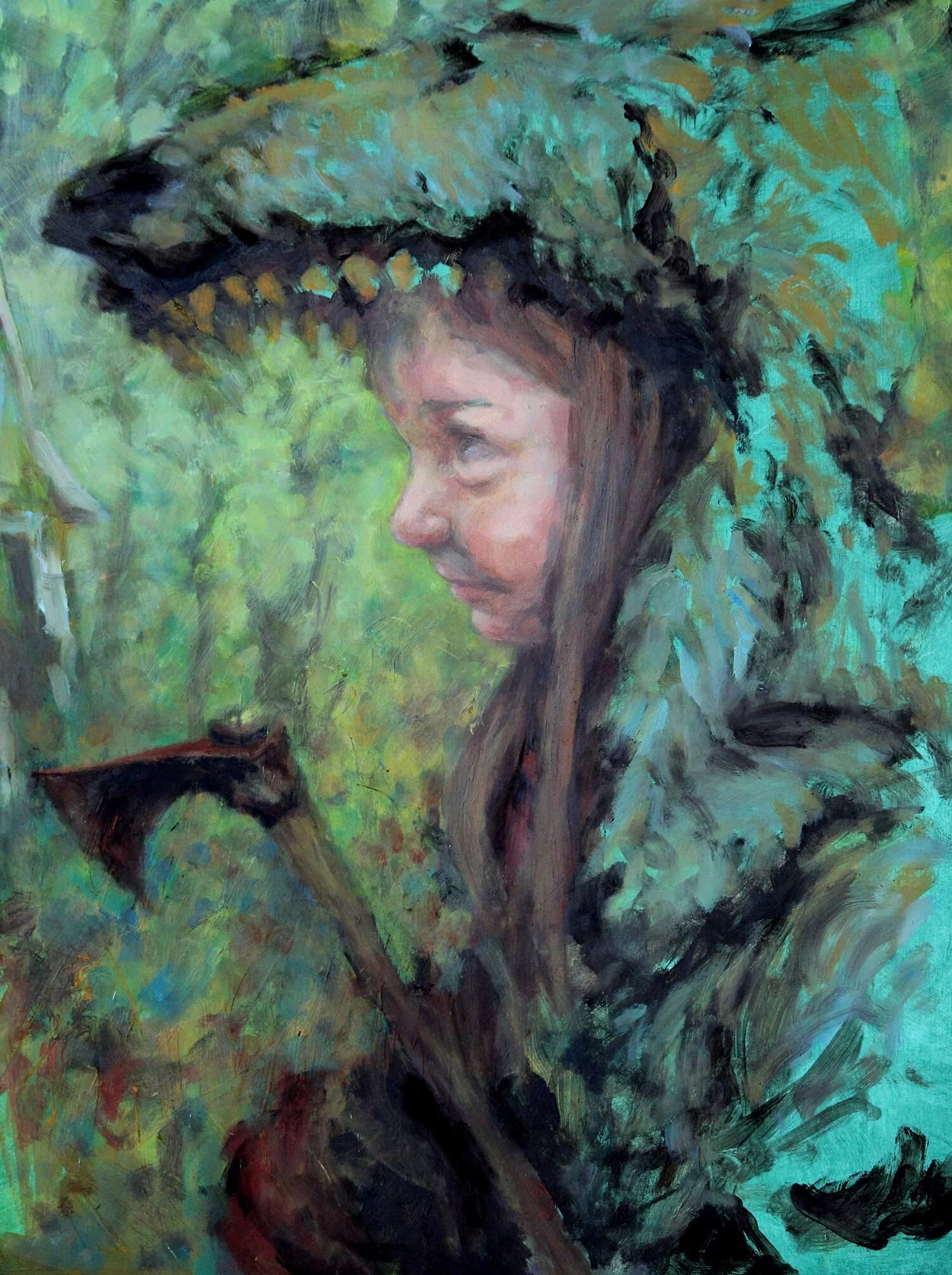
Drew Tucker builds his fantasy art directly out of his own life. From 1990s scanner constraints to family folklore and sympathetic magic, Tucker reflects on three decades of letting the paint have a voice.